
Introduction to Gilsonite in Drilling Fluids
Gilsonite is a naturally occurring hydrocarbon resin, also known as Natural Asphalt, Asphaltite, or Uintaite, widely used in drilling fluid systems throughout the oil and gas industry. Due to its unique sealing, plugging, filtration control, and wellbore-strengthening properties, Gilsonite has become one of the most effective additives for both water-based and oil-based drilling muds.
In water-based drilling fluids, Gilsonite functions as a high-performance filtration control agent, while in oil-based muds (OBM), it acts primarily as a fluid-loss control additive. Its ability to form thin, durable filter cakes and seal micro-fractures helps maintain wellbore stability, reduce formation damage, and improve drilling efficiency.

What are Drilling Fluids?
Drilling fluids, commonly known as drilling muds, are specially engineered fluids used during drilling operations to assist in the construction of oil, gas, geothermal, and water wells. These fluids perform numerous critical functions including cooling and lubricating the drill bit, transporting drill cuttings to the surface, controlling formation pressure, and maintaining wellbore stability.
- Water-Based Muds (WBM) – Most widely used and environmentally friendly systems.
- Oil-Based Muds (OBM) – Designed for challenging drilling conditions and high-performance requirements.
- Synthetic-Based Muds (SBM) – Advanced systems combining environmental and technical advantages.
Role of Gilsonite in Drilling Fluid Systems
Gilsonite has been used in drilling operations for decades due to its exceptional ability to control fluid loss, stabilize shales, strengthen wellbores, and minimize drilling-related complications. Its natural bonding and sealing properties allow it to perform effectively in both conventional and high-pressure/high-temperature drilling environments.
Fluid Loss Control
Reduces filtrate invasion into permeable formations and improves drilling efficiency.
Shale Stabilization
Protects water-sensitive formations and minimizes borehole enlargement.
Wellbore Strengthening
Seals micro-fractures and strengthens weak formations.
Lubricity Improvement
Reduces torque and drag, especially in directional and horizontal wells.
General Description of Fluid Loss Control (FLC)
Fluid Loss Control (FLC) is one of the most critical functions of modern drilling fluids. Gilsonite actively contributes to FLC by forming a thin, impermeable filter cake that minimizes the invasion of drilling fluids into permeable formations. This reduces formation damage while improving wellbore stability and drilling performance.
Gilsonite has been scientifically proven to reduce borehole instability in water-sensitive shales, minimize stuck pipe incidents, and improve filter cake quality through both physical and chemical sealing mechanisms.
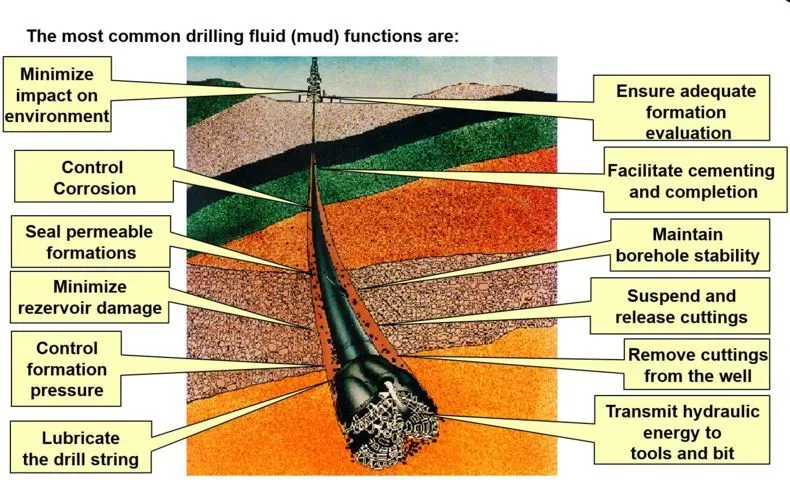
Functions of Drilling Fluid Loss Control (FLC)
Cuttings Removal
Efficiently transports drill cuttings to the surface.
Pressure Control
Provides hydrostatic pressure to prevent formation fluid influx.
Wellbore Stability
Maintains borehole integrity throughout drilling operations.
Formation Sealing
Creates an effective barrier across permeable formations.
Cooling & Lubrication
Keeps drilling tools cool and reduces wear.
Corrosion Control
Protects drilling equipment and tubulars from corrosion.
Reservoir Protection
Minimizes formation damage during drilling activities.
Environmental Protection
Supports safer and more sustainable drilling operations.
Benefits of Gilsonite in Drilling Fluids
| Benefit | Performance Impact |
|---|---|
| Wellbore Strengthening | Improves formation integrity and fracture resistance. |
| Fluid Loss Control | Reduces filtrate invasion and formation damage. |
| Shale Stabilization | Prevents sloughing and shale collapse. |
| Lost Circulation Prevention | Seals fractures and porous zones. |
| Filter Cake Improvement | Produces thin, durable, and lubricious filter cakes. |
| Differential Sticking Reduction | Minimizes stuck pipe incidents. |
| HPHT Compatibility | Maintains performance under extreme temperatures and pressures. |
| Environmental Safety | Natural and non-toxic drilling additive. |
Wellbore Strengthening Mechanism
Gilsonite strengthens the wellbore through multiple mechanisms. Its malleable particles bridge micro-fractures and low-porosity formations while simultaneously creating a continuous protective layer along the wellbore wall.
- Reduces pore pressure transmission.
- Seals micro-fractures in shale formations.
- Protects low-permeability sands.
- Maintains inter-bedded formation stability.
- Creates an effective filter cake.
- Produces a protective “Smear Effect” along the borehole wall.
High Pressure / High Temperature (HPHT) Performance
Modern drilling operations increasingly encounter HPHT environments where conventional fluid-loss additives may fail. Gilsonite performs exceptionally well under elevated bottom-hole temperatures and high-pressure conditions.
The material maintains stability at temperatures exceeding 150°C (302°F) and contributes to reduced fluid loss, improved shale stability, and enhanced wellbore strengthening under extreme drilling conditions.
Prevention of Differential Sticking
Differential sticking occurs when the drill string becomes trapped against the wellbore wall due to excessive pressure differentials. Gilsonite significantly reduces the risk of differential sticking by sealing permeable formations and improving filter cake lubricity.
The resulting thin and smooth filter cake minimizes contact area between the drill string and the wellbore wall, reducing sticking incidents and improving operational efficiency.
Health, Safety and Environmental Advantages
As a naturally occurring hydrocarbon mineral, Gilsonite offers several environmental and safety advantages over synthetic drilling fluid additives.
Non-Toxic
Safe handling characteristics compared to many synthetic alternatives.
Non-Carcinogenic
Does not present known carcinogenic risks during normal use.
Non-Mutagenic
Supports safer workplace environments.
Lower HSE Impact
Reduces environmental concerns associated with drilling fluid additives.
Cost Advantages of Gilsonite
Gilsonite delivers significant economic benefits in both water-based and oil-based mud systems. Compared to many specialty polymers and synthetic additives, Gilsonite provides equivalent or superior drilling performance at substantially lower cost.
| Application | Cost Benefit |
|---|---|
| Water-Based Mud (WBM) | Typically 25–50% lower cost than sulfonated asphalt alternatives. |
| Synthetic-Based Mud (SBM) | Can reduce additive costs by more than 80% compared to premium co-polymers. |
| HPHT Wells | Improves fluid-loss performance while lowering overall well costs. |
Conclusion
Gilsonite has established itself as one of the most effective and versatile additives used in modern drilling fluid systems. Its unique ability to control fluid loss, strengthen the wellbore, stabilize shales, prevent lost circulation, and improve filter cake quality makes it invaluable for both conventional and challenging drilling environments.
Whether utilized in water-based muds, oil-based muds, or synthetic drilling systems, Gilsonite delivers measurable improvements in drilling efficiency, wellbore stability, environmental performance, and cost control. As drilling operations continue to move toward deeper, hotter, and more complex formations, Gilsonite remains a proven solution for enhancing drilling fluid performance and ensuring successful well construction.