
Emulsion Grade Bitumen
Emulsion Grade Bitumen is a specialized road binder produced by dispersing bitumen in water with the aid of carefully selected emulsifiers. This process creates a low-viscosity, easy-to-handle product that can be applied without the need for high heating temperatures. Due to its excellent workability, safety, and environmental advantages, bitumen emulsion is widely used in road construction, maintenance, waterproofing, surface dressing, and various pavement preservation applications.
Unlike conventional bitumen, emulsion grade products can be stored, transported, and applied more efficiently while maintaining strong bonding performance with aggregates. Their versatility has made them an essential component in modern paving and infrastructure projects worldwide.

Composition of Emulsion Grade Bitumen
Bitumen emulsion consists primarily of bitumen, water, and emulsifying agents. Since bitumen and water naturally separate, emulsifiers are used to stabilize the mixture and keep bitumen droplets suspended uniformly within the water phase.
Bitumen
The primary binding material that provides adhesion, waterproofing, and durability.
Water
Acts as the dispersion medium, reducing viscosity and allowing application at lower temperatures.
Emulsifier
Stabilizes the mixture and prevents bitumen droplets from separating during storage and transportation.
Production Process
The production of bitumen emulsion is carried out using specialized equipment known as a colloid mill. In this process, heated bitumen is mixed with water and emulsifying agents under controlled conditions. The colloid mill breaks the bitumen into microscopic droplets that remain suspended in water, creating a stable and uniform emulsion.
Several manufacturing parameters must be carefully controlled, including droplet size, temperature, emulsifier concentration, and mixing intensity. Proper control ensures product consistency, storage stability, and reliable field performance.
Types of Bitumen Emulsion
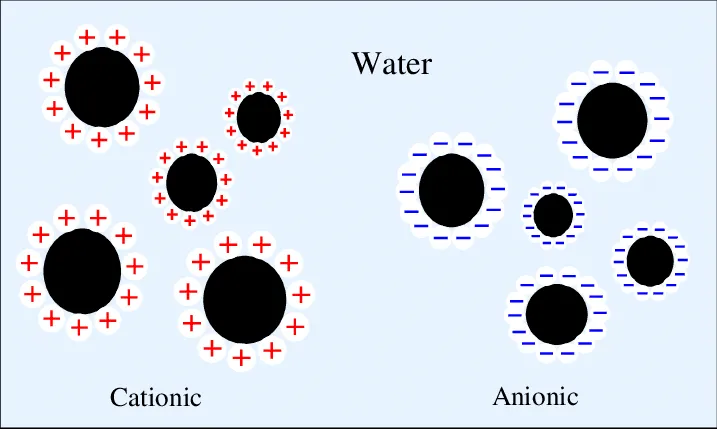
Classification by Electrical Charge
| Type | Description |
|---|---|
| Anionic Emulsion (A) | Contains negatively charged bitumen particles and is suitable for specific aggregate types. |
| Cationic Emulsion (C) | Contains positively charged bitumen particles and offers excellent adhesion with most aggregates. |
Classification by Setting Time
| Grade | Characteristics |
|---|---|
| Rapid Setting (RS) | Breaks quickly and is ideal for surface dressing and spray applications. |
| Medium Setting (MS) | Provides moderate mixing time and is suitable for aggregate blending. |
| Slow Setting (SS) | Offers extended workability for slurry seals and stabilization projects. |
Key Grading Factors
The quality and performance of emulsion grade bitumen are evaluated using several important grading parameters that determine its suitability for different construction applications.
Viscosity
Controls flow characteristics and application behavior. Higher viscosity typically indicates higher bitumen content and improved coating performance.
Ductility
Measures the ability of bitumen to stretch without breaking, contributing to pavement flexibility and crack resistance.
Penetration
Indicates the hardness or softness of the bitumen, affecting performance under varying temperature conditions.
Storage Stability
Evaluates the emulsion's ability to remain uniform during storage without separation or sedimentation.
Applications of Emulsion Grade Bitumen
Due to its versatility and ease of application, emulsion grade bitumen is used extensively across road construction and maintenance operations.
Road Construction
Used for tack coats, prime coats, surface dressing, and pavement preservation treatments.
Road Maintenance
Ideal for crack sealing, patching, and extending pavement service life.
Waterproofing
Provides moisture protection for foundations, structures, and construction materials.
Cold Mix Asphalt
Allows asphalt production without high heating requirements, improving safety and sustainability.

Advantages of Emulsion Grade Bitumen
| Advantage | Benefit |
|---|---|
| Low Temperature Application | Reduces energy consumption and improves worker safety. |
| Excellent Adhesion | Provides strong bonding with aggregates and pavement surfaces. |
| Environmentally Friendly | Produces lower emissions compared to conventional hot-applied bitumen. |
| Easy Handling | Simplifies transportation, storage, and field application. |
| Versatile Performance | Suitable for a wide variety of road construction and maintenance projects. |
Conclusion
Emulsion Grade Bitumen plays a vital role in modern infrastructure development by combining the performance of traditional bitumen with the convenience of water-based technology. Its unique composition, flexible grading system, and wide range of applications make it one of the most practical and efficient paving materials available today.
Whether used in road construction, maintenance, waterproofing, or cold mix applications, bitumen emulsions deliver reliable performance, improved safety, and enhanced sustainability. As construction technologies continue to advance, emulsion grade bitumen remains a cornerstone material for durable and cost-effective infrastructure solutions worldwide.